IDAN SHADI
Infinity Quantum
Timeline
Mar - Apr 2023
Client
Infinity Quantum Startup
MY ROLE
Product UX/UI Lead
Project Overview
My Responsibility
The Challenge
Quantum researchers and engineers faced a fragmented, high-complexity interface that hindered experimentation. The existing tools forced users to navigate scattered data, leading to costly errors and inefficient resource usage.
01
Fragmented Workflows
02
Critical Decisions
03
Cognitive Fatigue
Tagline
Research & Process
Key Design Focus Areas
- Hiding complexity until needed to reduce cognitive load during initial monitoring.
- High-contrast interface specifically tuned for low-light lab environments.
- Real-time feedback mechanisms to build trust and prevent budget overruns.
Market Analysis
Analyzed competitors (AWS Braket, IBM Quantum, Azure) to identify gaps in cost transparency and usability for non-experts.
Iterative Design
Progressed from low-fi wireframes to a cohesive hi-fi design system, validating logic with users at each stage.
Market Analysis
Analyzed competitors (AWS Braket, IBM Quantum, Azure) to identify gaps in cost transparency and usability for non-experts.
Iterative Design
Progressed from low-fi wireframes to a cohesive hi-fi design system, validating logic with users at each stage.
About Dr. Maya Levi
Dr. Maya Levi is an experienced quantum researcher working on complex experiments that require constant iteration, monitoring, and refinement. She often runs multiple jobs in parallel and relies heavily on accurate logs, calibration data, and resource availability. Her work demands clarity and speed—any friction in the interface directly slows down scientific progress.

Goals:
- Run quantum experiments efficiently.
- Monitor job states, logs, and calibration data.
- Access resources without waiting on admin support.
Frustrations:
- Dense tables that were hard to filter.
- Technical data displayed without structure.
- Slow navigation between jobs and resources.
Needs
- Dense tables that were hard to filter.
- Technical data displayed without structure.
- Slow navigation between jobs and resources.
About Dr. Amir Cohen

Goals:
- Approve credit requests and reservations.
- Monitor overall system health.
- Maintain consistency in organizational groups.
Frustrations:
- Hard to distinguish between parent groups and subgroups.
- Unclear approval workflows.
- No centralized summary of system status.
Needs
- A unified dashboard.
- Clear labeling of roles, groups, and permissions.
- Streamlined approval processes.
About Dr. Dana Weiss

Goals:
- Track team performance and resource costs.
- Manage users, roles, and access.
- Review experiment outcomes.
Frustrations:
- Scattered information across multiple pages.
- Tables with no grouping or hierarchy.
- Difficulty viewing organizational structure.
Needs
- High‑level insights at a glance.
- Clean, structured data tables.
- A predictable, consistent system.
User Persona
The Problem
Fragmented Data & Costly Mistakes
Researchers wasted hours cross-referencing SLURM logs, status codes, and error messages scattered across multiple pages. This cognitive overload led to missed errors and idle resources burning budget.
The Problem
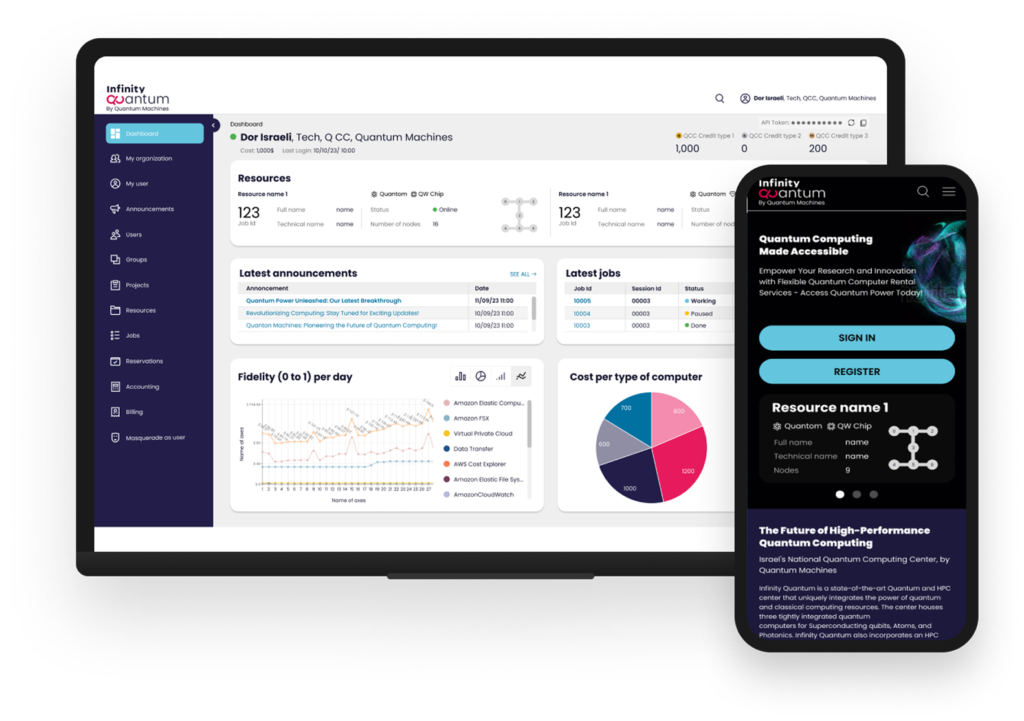
Structured Hierarchy & Progressive Disclosure
- Hiding complexity until needed to reduce cognitive load during initial monitoring.
- High-contrast interface specifically tuned for low-light lab environments.
- Real-time feedback mechanisms to build trust and prevent budget overruns.
- "I no longer need 5 tabs open just to check if my experiment failed." – Senior Quantum Engineer
The Problem
Opaque Costs & Booking Anxiety
The Solution
Guided Flow & Real-Time Transparency
- Guided Modal: A clear 4-step wizard (Machine → Phase → Parameters → Review) reduces cognitive load.
- Live Cost Preview: Dynamic pricing updates with every parameter change, visualized via pie charts.
- Proactive Validation: "Budget Exceeded" warnings appear before submission, preventing admin friction.
- Reduced over-provisioning and eliminated onboarding friction for non-technical users.
The Solution
Business Outcomes
- Reduced Over-provisioning
- Improved Resource Optimization
- Enterprise Scalability
Key Learnings
Balancing quantum complexity with enterprise usability revealed four critical insights that will shape the future roadmap of the platform.